
AI for Marketing11 min read
AI Brief: October 2026
The month agents stopped waiting to be asked
 By Silviu Daniel Eftimie (opens in a new tab)Co-founder · CEO
Intro
#All through 2026 I have written a monthly AI brief for companies, applied to marketing and shared it privately. From now on, it will be public. You won’t find the extra commentary that comes up in client meetings or the less obvious insights that stay there.
#What you will find are seven sections, in the index on the right, each one built to be skimmed:
#Every item is a headline, a line on why it matters and a link. Skim, click and go where it interests you.
The proactive agent shift
#Between 11 August and 21 October, five companies launched personal agents that act instead of answering: xAI’s Grok Bot (opens in a new tab), Instinct (opens in a new tab), Meta’s Muse (opens in a new tab), OpenAI’s dots (opens in a new tab) and Anthropic’s Claude Duet (opens in a new tab). Different products, same direction: “an assistant with its own browser, working for you in the background”, as Alejandro Navarro (opens in a new tab) put it.
- Grok Bot (opens in a new tab)x.ai ↗
- Instinct (opens in a new tab)instinct.com ↗
- Muse (opens in a new tab)ai.meta.com ↗
- dots (opens in a new tab)openai.com ↗
- Claude Duet (opens in a new tab)claude.com ↗
- Alejandro Navarro (opens in a new tab)linkedin.com ↗
What the five have in common
- A computer of their own Cloud machine, laptop closed: Grok Bot, Muse, dots and Duet.
- Where you already talk WhatsApp (Muse), texts and calls (Instinct), Slack and Teams (dots), text or voice (Duet).
- Proactive, in different doses
- Duet: morning brief
- dots: read-only research
- Muse: goal alerts
- Grok Bot: starts work before you ask
- Approval is the default Muse, dots, Duet and Grok Bot ask before they send, pay or sign.
- Four of the five can pay Muse, Grok Bot, Instinct and Duet. dots has no wallet.
The five side by side
| Agent | Launched | Lives in | How it is proactive | Access |
|---|---|---|---|---|
| Grok Bot (xAI) | 11 Aug | Mac and iOS app | Works 24/7 and comes back for approval | Premium from $30/month, Teams and Enterprise |
| Instinct (startup) | Aug | Texts, WhatsApp, calls | Not stated | Invite-only beta |
| Muse (Meta) | 8 Sep | iOS, Android, WhatsApp, Mac | Plans around your goals, watches and alerts | Free tier, $20 or $100/month; US, 18+ |
| dots (OpenAI) | 29 Sep | ChatGPT, Slack, Teams, voice | Read-only research while idle | Pro (not in the EEA, UK or Switzerland), Business Premium; Enterprise in beta |
| Claude Duet (Anthropic) | 21 Oct | iOS, Android, claude.ai | Morning brief, checks every few hours | Waitlist for Pro and Max; US only |
#From Spain, most of this isn’t open to consumers yet: Muse and Duet are US-only and dots on the Pro plan excludes the EEA. For a company, the way in today is dots on Business Premium or Enterprise.
Google: results and ads
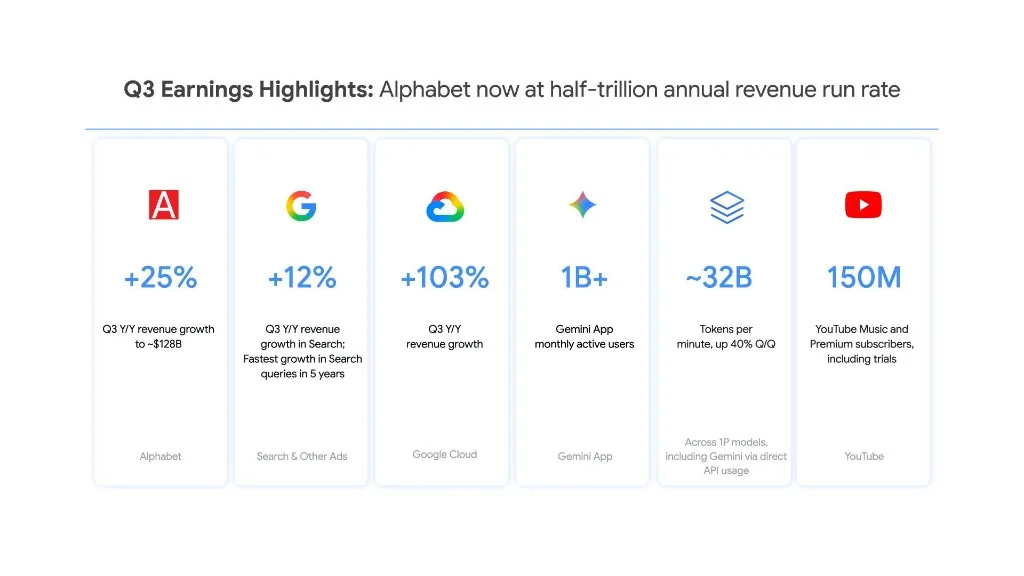
- Alphabet Q3: Search queries are growing at their fastest in five years (opens in a new tab) AI Mode queries are three times longer, Cloud grew 103% and the Gemini app has a billion users (full remarks (opens in a new tab)).
Google: models
- Gemini 4 Argon is generally available (opens in a new tab) Reads text, images, video, audio and PDFs; $2 per million input tokens and $10 output until 30 November, then $4 and $20. Long decode (opens in a new tab) writes up to a million tokens in one answer. Demos: Alexander Chen’s Spiral piano (opens in a new tab), Parth Patel’s procedural landscape (opens in a new tab) and Rohit Kelapure’s legacy migration benchmark (opens in a new tab).
- Gemini 4 Carbon: announced, not open yet (opens in a new tab) First on the Artificial Analysis Intelligence Index, but only selected cyber defenders can use it. Everyone else gets it “as soon as possible” at Argon’s price (Logan Kilpatrick (opens in a new tab)).
- Genie 4 builds worlds you can walk through, with sound (opens in a new tab) Research preview, “soon” for Google AI Ultra; Google is testing it with filmmakers for previsualisation.
- EmbeddingGemma 2 (opens in a new tab) An open model that makes text, code, images, audio and video searchable on a phone. Built on it: Foresight (opens in a new tab), a free Mac app for meeting notes that never leave the machine and DigUp (opens in a new tab), an independent search engine for your own files.
- Gemini 4 Argon is generally available (opens in a new tab)blog.google ↗
- Long decode (opens in a new tab)linkedin.com ↗
- Spiral piano (opens in a new tab)linkedin.com ↗
- procedural landscape (opens in a new tab)linkedin.com ↗
- legacy migration benchmark (opens in a new tab)linkedin.com ↗
- Gemini 4 Carbon: announced, not open yet (opens in a new tab)blog.google ↗
- Logan Kilpatrick (opens in a new tab)linkedin.com ↗
- Genie 4 builds worlds you can walk through, with sound (opens in a new tab)youtube.com ↗
- EmbeddingGemma 2 (opens in a new tab)blog.google ↗
- Foresight (opens in a new tab)developers.google.com ↗
- DigUp (opens in a new tab)github.com ↗
Google Cloud and agents
- Google’s agent stack, now for customers: Gemini at Work (opens in a new tab), Agent Compute Engine (opens in a new tab) and Harness² (opens in a new tab) Our read: Google’s internal agent machinery (think Jetski), packaged as Gemini for business.
- Gemini agent: works for hours or days inside Gmail, Docs and Sheets, on Gemini or Claude, with a spending cap. Ulta Beauty tripled digital conversion
- Agent Compute Engine: a micro-VM for each agent that pauses while it waits for a person. Preview in the coming months
- Harness²: tunes prompts, tools and memory automatically, for up to 11.5 points more on a workplace benchmark
- OpenAI models arrive on Google Cloud (opens in a new tab) GPT-6 Astra, GPT-6.1 Sol and GPT-6 Luna are in private preview, billed against existing commitments; general availability “in the coming weeks” (OpenAI (opens in a new tab)).
- Knowledge Catalog learns your business definitions (opens in a new tab) The new name of Dataplex, Google’s data governance tool (the one used for data mesh). It proposes what “AOV” or “premium customer” mean, with a citation and a person approves. Google reports almost 4x the accuracy; in preview (Firat Elbey (opens in a new tab), Honza Fedak (opens in a new tab)).
- Gemini at Work (opens in a new tab)cloud.google.com ↗
- Agent Compute Engine (opens in a new tab)cloud.google.com ↗
- Harness² (opens in a new tab)github.com ↗
- OpenAI models arrive on Google Cloud (opens in a new tab)cloud.google.com ↗
- OpenAI (opens in a new tab)openai.com ↗
- Knowledge Catalog learns your business definitions (opens in a new tab)cloud.google.com ↗
- Firat Elbey (opens in a new tab)linkedin.com ↗
- Honza Fedak (opens in a new tab)linkedin.com ↗
- Agent Studio Design, test and run agents by drag and drop and compare models side by side, Claude and Grok included.
- Agents CLI (opens in a new tab) Teaches any coding assistant to build, evaluate and deploy agents on Google Cloud.
- SSH into Cloud Run (opens in a new tab) Preview for engineers: open a shell in a running container and debug without redeploying.
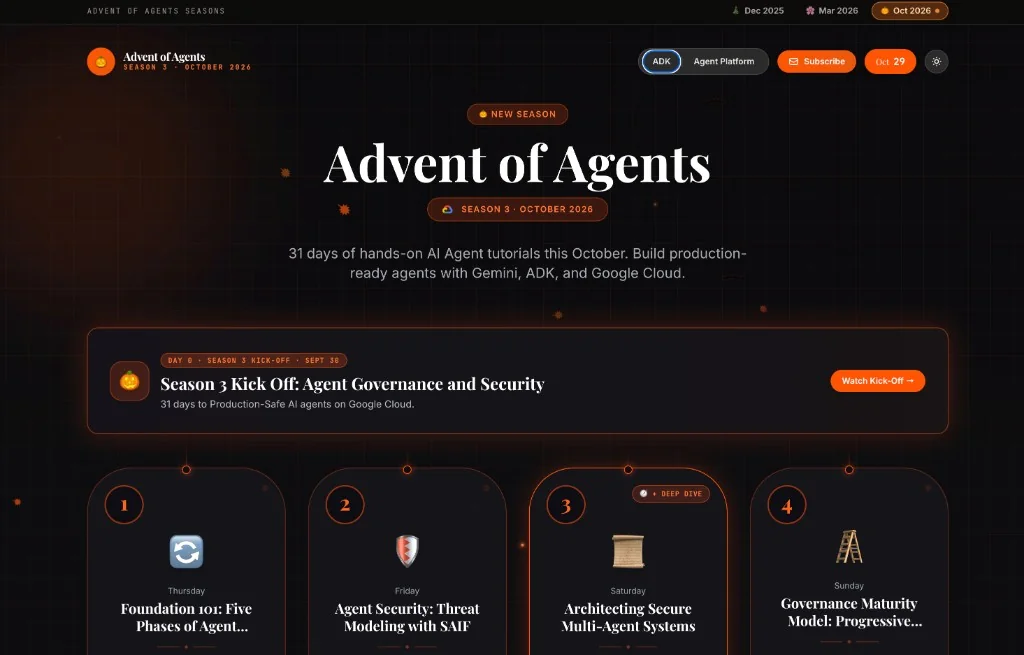
- Advent of Agents (opens in a new tab) Five-minute daily lessons on securing agents; on day 16 an agent pays only after you approve the exact cart.
- Agents CLI (opens in a new tab)github.com ↗
- SSH into Cloud Run (opens in a new tab)docs.cloud.google.com ↗
- Advent of Agents (opens in a new tab)adventofagents.com ↗
Google for small business
- The Gemini app gets a home for businesses (opens in a new tab) One place inside Gemini to build your brand, analyse your finances and understand your customers. Three features: brand visuals, images and full marketing campaigns that remember your brand kit, colours and style; finances in seconds, with photos of receipts, invoices or spreadsheets turned into financial models and interactive dashboards; and your daily apps, connected straight to Google Business Profile, Ads and Workspace and to Canva, Shopify, Adobe, Wix and Dropbox (Lino Cattaruzzi, in Spanish (opens in a new tab)).
- Google Business Home (opens in a new tab) A separate product, in invite-only beta in the US and UK: one dashboard for Business Profile, YouTube, Ads and Merchant Center. Not in Spain yet.
- The Gemini app gets a home for businesses (opens in a new tab)blog.google ↗
- Lino Cattaruzzi, in Spanish (opens in a new tab)linkedin.com ↗
- Google Business Home (opens in a new tab)linkedin.com ↗
Anthropic
Claude for video
#Editable video, made as code: the result is a project you can change, not a flat file. The film above is the example: Mo Bitar’s reaction to “Western civilization”, a viral piece he says is “all code”.
- Prompt Motion (opens in a new tab) A collection of motion videos made with Opus 5.5, prompts and skills included.
- snapcn (opens in a new tab) A library of components (opens in a new tab) for product demo videos in React, which people pair with Claude Code.
- Khulan Dav (opens in a new tab) Had Claude cut a travel video to the beat inside DaVinci Resolve.
- Prompt Motion (opens in a new tab)prompt-motion.com ↗
- snapcn (opens in a new tab)snapcn.dev ↗
- components (opens in a new tab)snapcn.dev ↗
- Khulan Dav (opens in a new tab)linkedin.com ↗
Claude’s new small model
- Claude Haiku 5.5 (opens in a new tab) $0.10 per million input tokens and $0.50 output, about 75% cheaper than Haiku 4.5 and on computer use it jumps from 15.7% to 72.4%: cheap enough for tagging, lead scoring and live support at volume.
- Claude Haiku 5.5 (opens in a new tab)anthropic.com ↗
Claude agents
- Building effective agent automations (opens in a new tab) A daily-brief agent on Claude Managed Agents. Rules for any automated report: read from where you left off, say when a source failed, cap the spend per run.
- Claude Managed Agents: dynamic workflows (opens in a new tab) In public beta. A lead agent writes a plan that runs across up to 1,000 agents in phases and combines the results. In the launch test, 70 bugs planted in a 116K-line codebase: a single agent found 14, 15 and 27; the workflow found 66 in each of 3 runs. It uses a lot of tokens, so start with a scoped task.
OpenAI

ChatGPT and models
- Dev Day: ChatGPT wants to be a distribution channel (opens in a new tab) Sign in with ChatGPT, plugins suggested mid-conversation and a Marketplace where companies pay partners such as Adobe, Figma, HubSpot and Salesforce from their OpenAI commitment.
- GPT-6 and Intelligent UI for everyone (opens in a new tab) All 1.2 billion weekly users get GPT-6, with answers built from charts, forms, maps and comparisons. Expect fewer clicks out to websites.
- GPT-6.1 Terra (opens in a new tab) $1 per million input tokens and $5 output, half its predecessor; by OpenAI’s numbers it matches GPT-6 Astra on computer tasks at a tenth of the price.
- OpenAI Signals (opens in a new tab) The first public dataset of ChatGPT’s work use: 165 activities in nearly 100 countries, consumer plans only.
OpenAI Decisions API
- Decisions API (opens in a new tab) Generally available: yes or no, which option, what score, from text, images or JSON, at $0.10 per million input tokens with output free.
- Jev gets eyes: about 60% cheaper than the Decisions API (opens in a new tab)
- Cost: 0.8 seconds and $0.00024 per static ad, about 2 cents per 100 (Filip Knyszewski’s own test; video is next).
- Creative leaderboard: score ads from 0 to 1 on creative patterns and rank them per objective.
- Confidence per tag: ad format came back at 0.97, funnel stage at 0.21, so you drop the weak ones.
- Element map: coordinates for the CTA, logo, price or face: “the CTA sits in the lower third”.
ChatGPT ads
- New formats and measurement (opens in a new tab)
- Format: a visual ad with product images, shown during image generation to Free and Go users; US tests start this month.
- Conversions: send them from your own systems with Hightouch, Tealium or LiveRamp.
- Attribution: Conversions API with AppsFlyer, Adjust, Northbeam, Triple Whale, DV Rockerbox and others.
- Incrementality: early geo tests with Haus, Measured and WorkMagic.
- Brand safety: Negative Phrases and pilots with DoubleVerify and IAS.
- Early result: WeightWatchers’ cost per acquisition 15.3% below its paid search (DV Rockerbox).
- How the ChatGPT ad stack works (opens in a new tab)
- Standard ad tech at the core: ANN retrieval, eligibility filtering and a quality-adjusted auction.
- An LLM decides what enters the auction: it reads the intent behind the conversation, how many queries to run and which candidates compete. It does not set prices or pick the winner; the deterministic auction does.
- Context apart from the creative: each ad carries a note on why it fits that conversation.
- Ads never delay an answer: “Returning no ad is an ordinary, successful outcome.”
- Risks, per Yuriy Igumnov (opens in a new tab): an opaque LLM complicates audits and compliance and prompt injection can come through conversations and advertiser creatives.
- Still missing: latency, cost per opportunity, fill rate, eCPM, CTR, auction type and billing events.
- New formats and measurement (opens in a new tab)openai.com ↗
- How the ChatGPT ad stack works (opens in a new tab)openai.com ↗
- Yuriy Igumnov (opens in a new tab)linkedin.com ↗
TheOven: Loop
#Loop is leaving beta. It is TheOven’s own product: an intelligent system in three layers that tells the people who run a client’s Google Ads what to change each week and why. We have been testing it with two clients, a third is about to join and their feedback is shaping every iteration.
#It connects mainly to Google Ads through BigQuery Data Transfer and also integrates with Search Ads 360 and other sources. The design borrows heavily from Andrej Karpathy’s autoresearch (opens in a new tab), where AI agents run research on their own: propose, test, keep what works.
- autoresearch (opens in a new tab)github.com ↗
The three layers
- Layer 1, data BigQuery Data Transfer and Search Ads 360 bring spend, search terms and conversions into one place.
- Layer 2, client context An onboarding of 10 to 15 questions captures the client’s business, priorities and account structure.
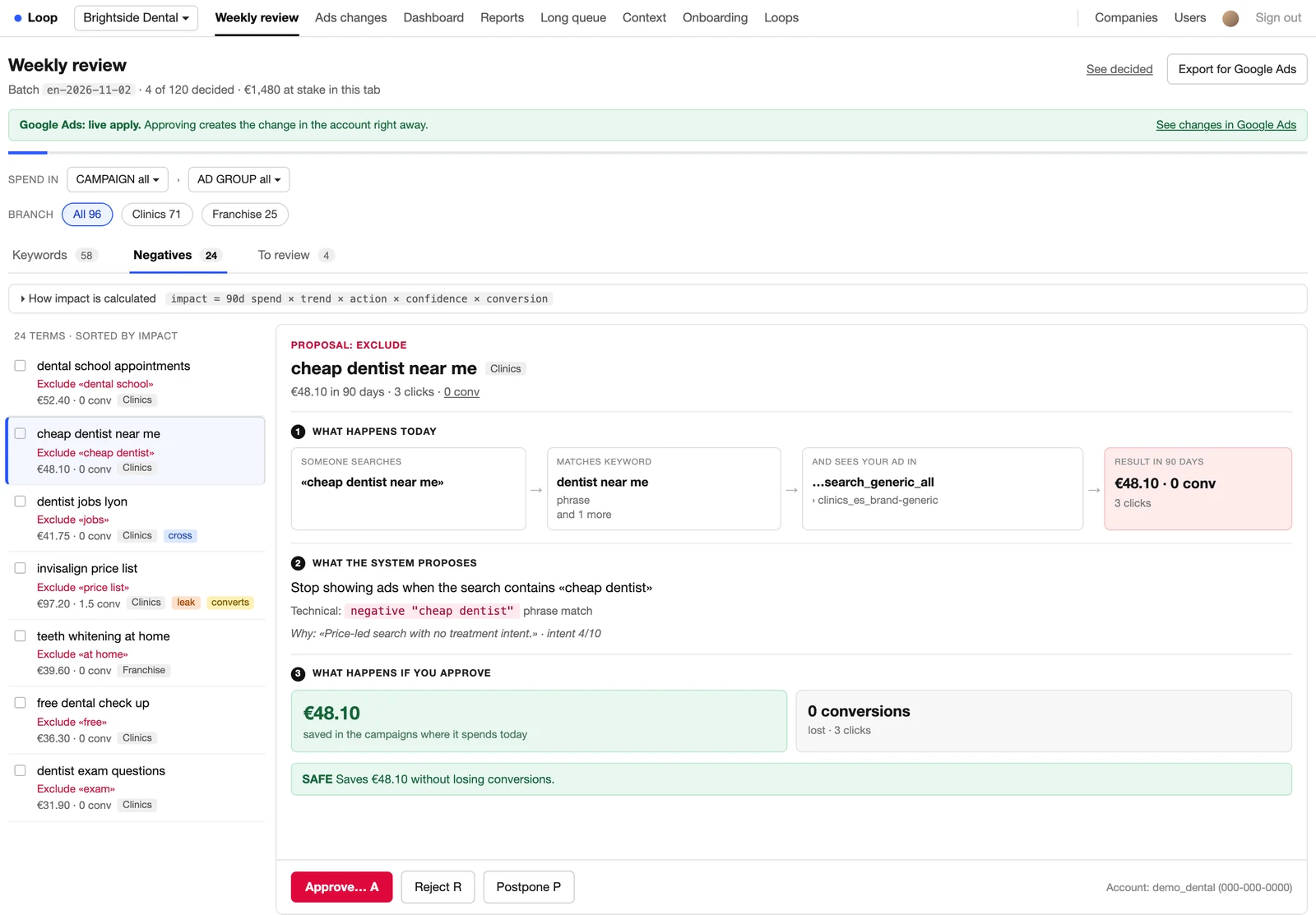
- Layer 3, the loop Every week, 10 to 15 steps produce a report of recommendations for the person who runs the account: which search terms to turn into keywords and which to block, ranked by the money at stake.
The operator stays in charge
#For each recommendation, the operator applies it or rejects it and a rejection has to say why. That reason goes into the context and the next recommendation weighs it against the data: the last 90 days of spend, what converted and what didn’t. The operator’s intuition becomes a hypothesis and the hypothesis gets tested.
#The system is generic and adapts to any number of companies. The difference is the judgement of whoever runs it: someone who truly knows how Google Ads works and what the client cares about. Those people are unicorns.
#iRead
When the buyer is an agent
- 34 hypotheses on AI agents and the digital economy (opens in a new tab) Malte Landwehr, 28 October. Paid placement weakens when an agent reads the whole list; reviews, specs and return rates beat brand advertising.
- The Agentic Web (opens in a new tab) André Bandarra (Chrome). The “agent-ready” checklist: be discoverable, be understood and expose tools such as checkout through WebMCP.
- Shopify Editions Fall ‘26 (opens in a new tab) Every store is “agent-ready by default”, with Shop Pay inside Muse, Claude Duet and Instinct and Shop Campaigns in 35+ new markets including the EU, paid only per sale.
- 34 hypotheses on AI agents and the digital economy (opens in a new tab)linkedin.com ↗
- The Agentic Web (opens in a new tab)bandarra.me ↗
- Shopify Editions Fall ‘26 (opens in a new tab)shopify.com ↗
Agentic advertising
- Amazon Ads Agent (opens in a new tab) Amazon’s DSP and console become one agentic platform with a chat for planning and an MCP server for your own agents; Spain is in the closed beta (Israel Ruesga (opens in a new tab)).
- Jev is the biggest phase shift in advertising technology (opens in a new tab) Joseph Hirsch, 28 September
- It decides, it doesn’t write: you give it a situation and it returns a structured answer with a confidence score, in milliseconds, for a fraction of a cent.
- Sell side: a seller agent prices every impression on its own merits (audience, context, content, time and demand) and sets a fixed price. No floor-price guessing, no rules written six months ago.
- Buy side: in a DSP or as a buyer agent, every opportunity is judged against what the campaign needs: worth it, at this price, for this goal? Yes or no, with a confidence score.
- Both at once is a market: a seller that knows what its inventory is worth, talking to a buyer that knows what it’s worth to them.
- Why LLMs weren’t enough: too slow and expensive for ten thousand pricing decisions a second, so agents ended up doing the paperwork around the transaction.
- The shift: the LLM keeps the conversation, planning and negotiation and the actual call moves to a fast, cheap, auditable layer. AI becomes the decisioning layer inside the ad stack.
- Amazon Ads Agent (opens in a new tab)advertising.amazon.com ↗
- Israel Ruesga (opens in a new tab)linkedin.com ↗
- Jev is the biggest phase shift in advertising technology (opens in a new tab)linkedin.com ↗
Where the moat went
- The SaaS model is being structurally replaced (opens in a new tab) Guillermo Flor, 15 October, on Satya Nadella’s argument
- Today: you buy software for its features.
- Agentic model: the business logic leaves the application and lives inside the agent.
- Why it matters: CRM, ticketing and project management were built by encoding business logic into UI and workflows. The software was the logic.
- What changes: foundation models and agent layers re-encode that logic directly and the application becomes a thin shell.
- Did software IP just become worthless? (opens in a new tab) My post from 13 October on ArtCraft, open-source clones of Adobe and Office apps written with Opus 5.5: value moves to data, distribution and trust.
To learn
- Agentic AI (opens in a new tab) Andrew Ng, DeepLearning.AI. About ten hours, free to audit; module 1 is enough if you’re not technical.
- How always-on agents work (opens in a new tab) Lee Robinson at Stanford CS146S, 45 minutes, on memory, triggers and the guardrails agents need.
- The #1 skill every forward deployed engineer must master (opens in a new tab) Priyanka Vergadia, 11 minutes: find the real problem before opening the toolbox.
- Agentic AI (opens in a new tab)deeplearning.ai ↗
- How always-on agents work (opens in a new tab)youtube.com ↗
- The #1 skill every forward deployed engineer must master (opens in a new tab)youtube.com ↗
To think
- How to be more ambitious (opens in a new tab) Felix Rieseberg, 13 October. Ask for the outcome, not the task and never let the model judge itself.
- Empires of AI (opens in a new tab) Ferguson, Klaassen and Schmidt, Foreign Affairs. Choosing an AI vendor is a dependency decision.
- How to be more ambitious (opens in a new tab)felixrieseberg.com ↗
- Empires of AI (opens in a new tab)foreignaffairs.com ↗
On the radar
- Google may be feeding scrapers fake results (opens in a new tab) Nozzle: since 20 September, 8.7% of first pages served to bots had their organic results swapped; Spain is among the least affected (4.8%) (Cyrus Shepard (opens in a new tab)). If your rank tracker dropped, check Search Console first.
- Flint, a coding model for your laptop (opens in a new tab) Open-weight (Apache 2.0); by the company’s figures, more than 125 tokens a second on a MacBook Pro.
- Anthropic at Inspirational’26 (opens in a new tab) Julia Hernández on what separates companies that test AI from those that change how they work. No recording yet.
- What a forward deployed engineer does at OpenAI (opens in a new tab) An on-demand panel and Colin Jarvis’s rule: “Start with the outcome, do what it takes to succeed, then follow with scale.”
- Google may be feeding scrapers fake results (opens in a new tab)nozzle.io ↗
- Cyrus Shepard (opens in a new tab)linkedin.com ↗
- Flint, a coding model for your laptop (opens in a new tab)linkedin.com ↗
- Anthropic at Inspirational’26 (opens in a new tab)linkedin.com ↗
- What a forward deployed engineer does at OpenAI (opens in a new tab)linkedin.com ↗
Events
5 November, Mutilva (Navarra) and online
#Del humano en el bucle al desarrollo desatendido (opens in a new tab), by 540, free and in Spanish. Mikel Ros on how much autonomy to give coding agents; one of their repositories went from 87 merged pull requests in August 2025 to 502 this year.
7 November, Madrid
#Claude Code Hackathon: Close the Books (opens in a new tab), a Claude Community event with a challenge by Talky. Free with approval. Build an AI finance team that closes the books of a synthetic company, scored on accuracy, fraud detection, safe autonomy and auditability.
12 November, Madrid
#Programmatic Breakfast: Agentic AI (opens in a new tab), by Programmatic Spain, in Spanish, with tickets from €75 (programme (opens in a new tab)). Samsung, Seedtag, Prisa Media, Taptap and others on “De campañas a sistemas: diseñar reglas es el nuevo media planning”. The one for media teams.
- Programmatic Breakfast: Agentic AI (opens in a new tab)linkedin.com ↗
- programme (opens in a new tab)programaticaly.com ↗
19 November, Mutilva (Navarra)
#IA + Software: pongámoslo a prueba (opens in a new tab), by 540, free and in Spanish. A hands-on workshop that continues the 5 November talk; bring a laptop.
Outro
#That was October. The next AI Brief arrives at the end of November, with the same format: what launched, why it matters for marketing and where to read more. See you then.
Sources
- Grok Bot (opens in a new tab)x.ai ↗
- Instinct (opens in a new tab)instinct.com ↗
- Muse (opens in a new tab)ai.meta.com ↗
- dots (opens in a new tab)openai.com ↗
- Claude Duet (opens in a new tab)claude.com ↗
- Alejandro Navarro (opens in a new tab)linkedin.com ↗
- Alphabet Q3: Search queries are growing at their fastest in five years (opens in a new tab)linkedin.com ↗
- full remarks (opens in a new tab)blog.google ↗
- Gemini 4 Argon is generally available (opens in a new tab)blog.google ↗
- Long decode (opens in a new tab)linkedin.com ↗
- Spiral piano (opens in a new tab)linkedin.com ↗
- procedural landscape (opens in a new tab)linkedin.com ↗
- legacy migration benchmark (opens in a new tab)linkedin.com ↗
- Gemini 4 Carbon: announced, not open yet (opens in a new tab)blog.google ↗
- Logan Kilpatrick (opens in a new tab)linkedin.com ↗
- Genie 4 builds worlds you can walk through, with sound (opens in a new tab)youtube.com ↗
- EmbeddingGemma 2 (opens in a new tab)blog.google ↗
- Foresight (opens in a new tab)developers.google.com ↗
- DigUp (opens in a new tab)github.com ↗
- Gemini at Work (opens in a new tab)cloud.google.com ↗
- Agent Compute Engine (opens in a new tab)cloud.google.com ↗
- Harness² (opens in a new tab)github.com ↗
- OpenAI models arrive on Google Cloud (opens in a new tab)cloud.google.com ↗
- OpenAI (opens in a new tab)openai.com ↗
- Knowledge Catalog learns your business definitions (opens in a new tab)cloud.google.com ↗
- Firat Elbey (opens in a new tab)linkedin.com ↗
- Honza Fedak (opens in a new tab)linkedin.com ↗
- Agents CLI (opens in a new tab)github.com ↗
- SSH into Cloud Run (opens in a new tab)docs.cloud.google.com ↗
- Advent of Agents (opens in a new tab)adventofagents.com ↗
- The Gemini app gets a home for businesses (opens in a new tab)blog.google ↗
- Lino Cattaruzzi, in Spanish (opens in a new tab)linkedin.com ↗
- Google Business Home (opens in a new tab)linkedin.com ↗
- Prompt Motion (opens in a new tab)prompt-motion.com ↗
- snapcn (opens in a new tab)snapcn.dev ↗
- components (opens in a new tab)snapcn.dev ↗
- Khulan Dav (opens in a new tab)linkedin.com ↗
- Claude Haiku 5.5 (opens in a new tab)anthropic.com ↗
- Building effective agent automations (opens in a new tab)claude.dev ↗
- Claude Managed Agents: dynamic workflows (opens in a new tab)linkedin.com ↗
- Dev Day: ChatGPT wants to be a distribution channel (opens in a new tab)alpic.ai ↗
- GPT-6 and Intelligent UI for everyone (opens in a new tab)openai.com ↗
- GPT-6.1 Terra (opens in a new tab)openai.com ↗
- OpenAI Signals (opens in a new tab)openai.com ↗
- Decisions API (opens in a new tab)openai.com ↗
- Jev gets eyes: about 60% cheaper than the Decisions API (opens in a new tab)linkedin.com ↗
- New formats and measurement (opens in a new tab)openai.com ↗
- How the ChatGPT ad stack works (opens in a new tab)openai.com ↗
- Yuriy Igumnov (opens in a new tab)linkedin.com ↗
- autoresearch (opens in a new tab)github.com ↗
- 34 hypotheses on AI agents and the digital economy (opens in a new tab)linkedin.com ↗
- The Agentic Web (opens in a new tab)bandarra.me ↗
- Shopify Editions Fall ‘26 (opens in a new tab)shopify.com ↗
- Amazon Ads Agent (opens in a new tab)advertising.amazon.com ↗
- Israel Ruesga (opens in a new tab)linkedin.com ↗
- Jev is the biggest phase shift in advertising technology (opens in a new tab)linkedin.com ↗
- The SaaS model is being structurally replaced (opens in a new tab)linkedin.com ↗
- Did software IP just become worthless? (opens in a new tab)linkedin.com ↗
- Agentic AI (opens in a new tab)deeplearning.ai ↗
- How always-on agents work (opens in a new tab)youtube.com ↗
- The #1 skill every forward deployed engineer must master (opens in a new tab)youtube.com ↗
- How to be more ambitious (opens in a new tab)felixrieseberg.com ↗
- Empires of AI (opens in a new tab)foreignaffairs.com ↗
- Google may be feeding scrapers fake results (opens in a new tab)nozzle.io ↗
- Cyrus Shepard (opens in a new tab)linkedin.com ↗
- Flint, a coding model for your laptop (opens in a new tab)linkedin.com ↗
- Anthropic at Inspirational’26 (opens in a new tab)linkedin.com ↗
- What a forward deployed engineer does at OpenAI (opens in a new tab)linkedin.com ↗
- Del humano en el bucle al desarrollo desatendido (opens in a new tab)luma.com ↗
- Claude Code Hackathon: Close the Books (opens in a new tab)luma.com ↗
- Programmatic Breakfast: Agentic AI (opens in a new tab)linkedin.com ↗
- programme (opens in a new tab)programaticaly.com ↗
- IA + Software: pongámoslo a prueba (opens in a new tab)luma.com ↗